Peptide Payment Processing Shut Down? What to Do Next
Peptide merchant account suspended or terminated? Learn what to review, how holds differ from shutdowns, and what to ask banks, gateways and solution providers.

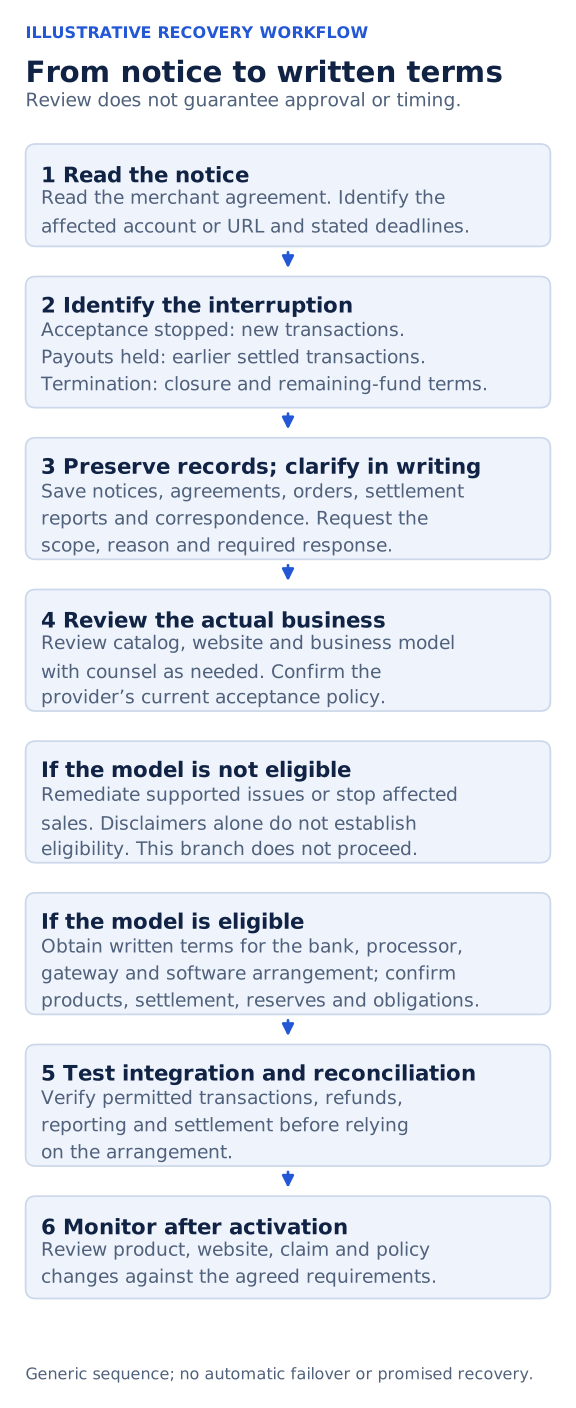
If your peptide business can no longer accept cards, start with the processor’s notice: what stopped, what money is being held, and what review is available? Before looking for a replacement account, review your products, buyers and marketing. A new checkout integration cannot resolve an unsupported business model.
For U.S. research-use-only suppliers, the next step is finding a payment program that has reviewed the complete operation. A payments solutions company can help coordinate the website review, software requirements, acquiring relationship and ongoing monitoring. Legal compliance, bank approval and uninterrupted processing cannot be guaranteed.
First, identify what “shut down” means
You may describe processing as “revoked,” but the provider’s precise status matters:
| Account condition | What it means for your response | What to request in writing |
|---|---|---|
| Payment acceptance suspended | New card payments are disabled, potentially while a review proceeds. | Reason, affected channels, requested evidence, deadline and review process. |
| Payouts held or a reserve imposed | Money is unavailable for transfer; acceptance may or may not continue. | Held amount, reserve terms, deductions, release conditions and payout status. |
| Account terminated | The provider has ended the processing relationship. | Effective date, remaining refund/dispute handling, outstanding balances and any reconsideration process. |
A reserve is not automatically an account closure. Stripe describes reserves as funds retained for potential refunds and disputes and says its reserves do not themselves stop payment acceptance. Your notice and agreement determine your situation. Stripe’s reserve explanation.
Save the notice, current balance, transaction exports, outstanding orders, tracking records and customer communications. Ask whether refunds remain available. Pause checkout options that cannot complete a payment; give customers accurate order and refund information. Do not quietly route the same sales through an unrelated account or misdescribe the catalog to a new provider.
Separate interrupted orders from held cash
Suppose 40 orders a day, each worth $100, cannot be processed. Separately, assume $10,000 in payouts from earlier completed sales is held throughout. Here is how those two amounts add up:
Hypothetical planning example
A processing interruption has two different dollar effects
Unprocessed gross order value and earlier held payouts are separate amounts. Neither is a profit forecast.
Assumptions
40 orders per day × $100 average order × days without acceptance.
Plus $10,000 in hypothetical held payouts from separate, earlier completed transactions.
- Earlier held payouts
- Unprocessed gross order value
- 1 day: Earlier held payouts: $10,000; Unprocessed gross order value: $4,000. Combined illustration: $14,000.
- 3 days: Earlier held payouts: $10,000; Unprocessed gross order value: $12,000. Combined illustration: $22,000.
- 7 days: Earlier held payouts: $10,000; Unprocessed gross order value: $28,000. Combined illustration: $38,000.
Hypothetical example: 40 orders × $100 × days. Held payouts concern different, earlier transactions. These amounts are not a forecast of lost revenue or profit; orders may return and held funds are not assumed lost.
Read the components separately. The data table below shows the exact amounts and combined illustration; these assumptions are not industry averages or a release timetable.
| Interruption | Unprocessed gross order value | Separately held payouts | Combined exposure |
|---|---|---|---|
| 1 day | $4,000 | $10,000 | $14,000 |
| 3 days | $12,000 | $10,000 | $22,000 |
| 7 days | $28,000 | $10,000 | $38,000 |
Why “research use only” does not settle the review
Product eligibility, marketing, customer access and financial risk need separate examination. A low dispute rate does not establish that a product is lawful or supported, and a disclaimer does not settle intended use.
In its August 24, 2026 warning letter to Royal Peptides LLC, FDA identified unapproved-new-drug violations. Website evidence indicated human drug use despite research-only disclaimers, including a peptide guide and calculator marketed alongside bacteriostatic water. Those findings concern that company’s products and conduct; they show why research-only wording must be assessed alongside the wider presentation. FDA’s Royal Peptides warning letter.
Stripe’s English-language FAQ, retrieved with its en-GB locale, describes conditional support for research-purpose peptides with measures preventing non-research purchases and account-level review. U.S. suppliers need confirmation of current requirements for their exact account, catalog and customer controls. The FAQ does not establish individual approval. Stripe’s prohibited and restricted businesses FAQ.
LegitScript’s guide asks reviewers to examine customer safeguards, the catalog and marketing that points toward personal use. Professional-researcher verification is one example it offers, rather than a universal requirement or merchant certification. Confirm the acquiring program’s own conditions. LegitScript’s peptide guide for payment processors.
If your business actually sells for human use, rewriting descriptions as “research” does not make that operation compliant. Obtain a qualified legal assessment of the actual products and sales model before seeking payment placement under a research-only description.
Review the whole website—and the operation behind it
A useful review includes product pages, labels, imagery, blogs, navigation, checkout language, advertising, customer messages and external links. Preserve dated copies before making corrections so you can explain what changed.
Use this checklist to organize a program-specific website review. Confirm the written conditions that apply to your account. The program requirements used to develop it are not universal rules, and their issuer and current applicability need confirmation.
| Website area | Review action | Evidence to retain | Responsible owner |
|---|---|---|---|
| Use and administration | Check for human-use, consumption, dosing, administration or treatment language inconsistent with this program. | Reviewed URLs, screenshots and corrected versions. | Merchant content owner. |
| Educational content | Identify dosing calculators, protocols and consumer use guides; resolve them against actual intended use and program conditions. | Tool inventory, linked-resource review and removal/change log. | Merchant operations and qualified adviser. |
| Claims | Review therapeutic, wellness, weight-loss and other human-benefit claims across site and ads. | Claim inventory and documented review decisions. | Merchant marketing owner. |
| Products and branding | Submit product names, GLP-related terms, labels, images and positioning for review. | Complete catalog, label files and written product decisions. | Merchant catalog owner; program reviewer. |
| Disclosures and access | Implement required disclaimers, research attestations, age gates or access controls as directed. | Requirement record, settings and evidence the controls work. | Merchant and software implementer. |
| Prohibited categories | Confirm prohibited categories. The program requirements used for this checklist exclude SARMs and steroids. | Approved product list and catalog-change log. | Merchant catalog owner; program reviewer. |
The merchant remains responsible for its content, edits and business conduct. Monitoring should create an actionable finding with an owner and resolution record. An alert alone does not correct the issue.
What a solutions company should coordinate
The value of a solutions company is having someone coordinate the website, technology and payment relationships together. Ask who owns each part and what they will deliver.
Prepare the complete business for review. Include the catalog, website and marketing inventory, buyer controls, fulfillment practices, processing history and prior closure notices. Disclose restrictions and terminations, and supply the documents the prospective program requests.
Confirm the acquiring relationship. The acquiring bank or acquiring program provides the merchant acceptance relationship; the processor handles transaction processing and settlement functions. The gateway passes payment information between checkout and the processing system. Providers can combine roles, so identify the entities named in your agreement. Stripe’s acquirer explanation, processor and gateway explanation.
Illustrative responsibility map
A gateway is one part of the processing arrangement
Ask who owns each decision and handoff. Software does not replace underwriting or legal review.
Merchant website
Products, claims, policies, orders and customer support.
Gateway
Routes payment messages; provides configured controls.
Processor
Processes transactions; provides agreed reporting.
Acquiring bank
Acquires card transactions; sets applicable account terms.
Logical payment-message path; actual contracts and service roles can differ.
Monitoring and solutions support: coordinate the arrangement
Website and catalog review · software configuration · underwriting documentation · issue escalation.
Support can identify gaps and help coordinate providers. The merchant owns its sales and content; legal and provider decisions remain with the appropriate authorities.
Confirm in writing
Approved products and URLs, responsibilities, reserves, settlement, disputes and change-review requirements.
Illustrative responsibilities vary by agreement. Coordinated support helps manage the review and implementation; providers make their own acceptance decisions. No provider endorsement, automatic failover or compliance guarantee is implied.
Scope the software around the permitted setup. Your ecommerce platform manages products, orders and customers; the gateway connects the payment flow. Confirm integrations, refunds, reporting and permitted use of stored payment tokens before planning a cutover. Roots’ independent gateway resource explains that connection.
Make monitoring part of the handoff. Agree how new products, pages, ads and material changes reach the program for review. Retain the conditions, responsible people and escalation contacts so an alert leads to a decision and a documented correction.
The software scope worth requesting
Ask for these capabilities in the implementation proposal. This is a software requirements list, not a claim that Roots supplies a proprietary peptide-compliance product.
| Capability | What to request |
|---|---|
| Website change alerts | Track pages, descriptions, images and links; assign each finding to a reviewer. |
| Research-customer controls | Support program-directed verification, attestations and access restrictions; protect review and exception records. |
| Catalog approval workflow | Hold products and material changes for review; retain the decision and approved version. |
| Refund, dispute and fulfillment records | Connect orders, shipments, customer contacts, refunds and response deadlines. |
| Settlement reconciliation | Match captured sales, fees, refunds, reserves and deposits; flag discrepancies. |
Ask what already exists, what needs configuration or development, who will operate it and what maintenance will cost. Software can enforce and document a process; it cannot decide product legality.
Questions to ask before signing
Get written answers about the acquiring entity, reviewed catalog, permitted customers, changes needing review, reserve and payout terms, volume and dispute conditions, refunds after closure, supported integrations and escalation contacts.
Compare those answers with the contract and software scope. “Peptide-friendly” does not establish acceptance of your business. See high-risk merchant payment solutions for the broader review process.
Frequently asked questions
Can a new gateway restore my peptide processing?
It can provide a technical connection to a compatible, permitted account. It cannot reverse another provider’s closure or make unsupported sales eligible. Confirm the acquiring arrangement first.
Is a research-only disclaimer enough?
No. Review the actual intended use, customers and marketing together. FDA’s Royal Peptides letter shows how contrary website evidence can outweigh research-only wording.
Can Stripe process research peptides?
Its retrieved FAQ describes conditional support with preventive measures against non-research purchases. Confirm current U.S. requirements for your account; do not treat the FAQ as approval of a particular catalog.
Does a reserve mean my account has been terminated?
No. Identify payment acceptance, payout availability and account status separately, using the provider’s written notice and terms.
Can monitoring guarantee that processing stays active?
No. It can help surface changes and document responses. The merchant must resolve findings, and providers retain their review and contractual decision processes.
What should I bring to an initial discussion?
Your website, complete catalog, customer controls, current notice, processing statements, open-order information and questions about software and settlement. Use the agreed secure channel for sensitive documents.
Discuss your peptide payment requirements. Bring your business model and processing notice so the conversation can address the website review, software and acquiring requirements together.